

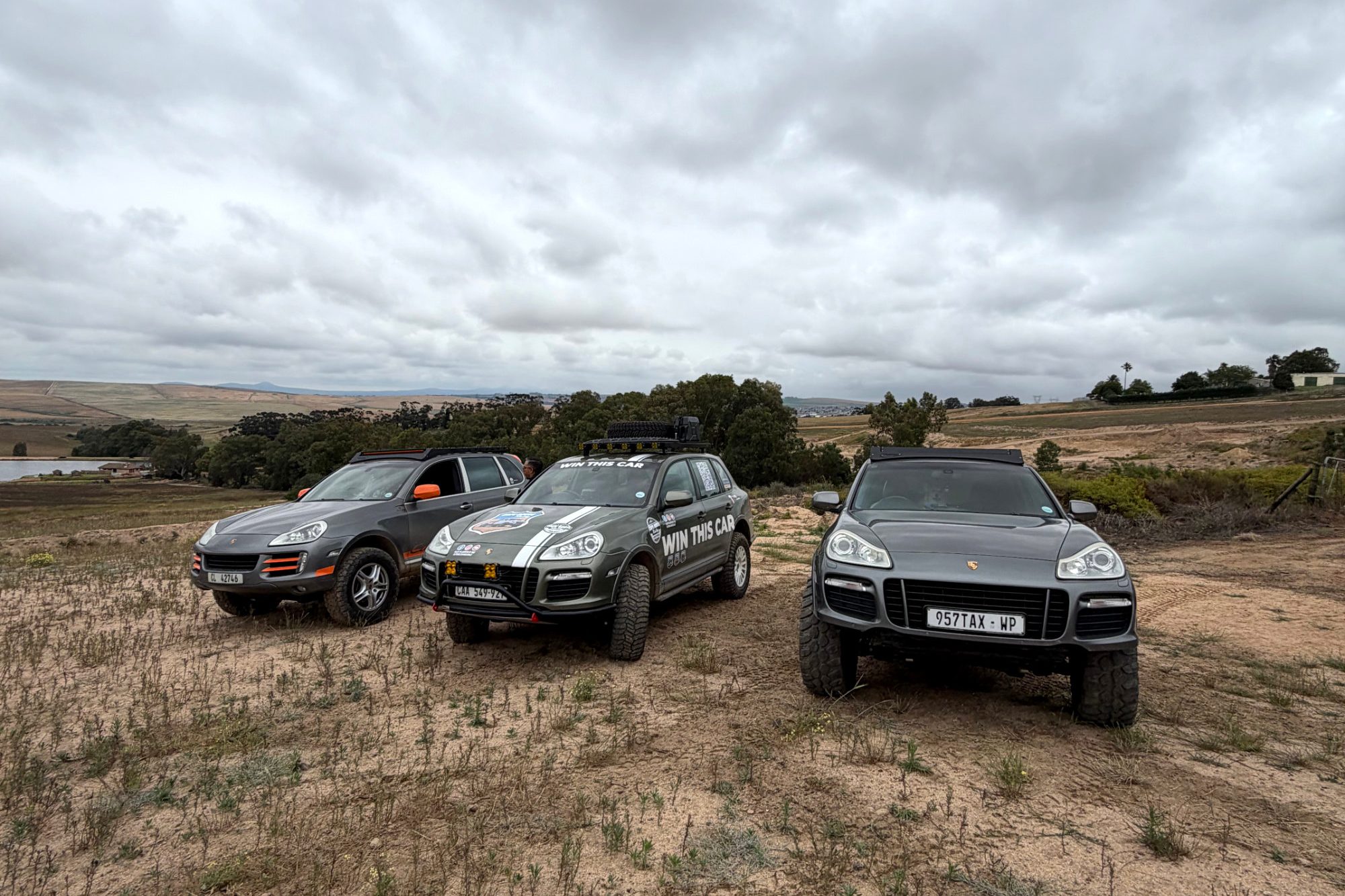
Yes, a Porsche Cayenne 957 will run 35-inch tyres. It just won’t do it on a bolt-on weekend. Getting a 35×12.5R18 under a first-gen Cayenne means a proper lift, new upper control arms, the right wheels, cutting metal and moving coolant lines. Here’s what the build actually involves, and why we don’t recommend it to everyone who asks.

A lifted first-generation Cayenne on Eurowise suspension.
Why 35s on a Cayenne are a big step
The 957 Cayenne (2007–2010) is a great base for an overland build: a proper low-range transfer case, a strong V8 or V6, and a chassis that handles rough roads far better than its badge suggests. Stock tyres sit at around 29–30 inches. Going to 35s is roughly five inches more tyre, and on a unibody car with independent suspension at all four corners, that tyre has to find space the factory never left for it.
The usual sticking points are the upper control arms, the back of the front wheel arch where it meets the rocker panel, and the heater coolant lines that run through the arch. Every one of them needs sorting before a 35 turns lock to lock without rubbing.
What you need to fit 35s on a Cayenne 957
This is the list we work from. Skip one and you’ll find it the first time the suspension compresses on full lock.
- A 3–4 inch lift kit. A lift doesn’t raise your ground clearance under the diffs (only the bigger tyre does that), but it gives the tyre room to move. We recommend 3–4 inches for 35s, such as the Eurowise Gen 1 3″ lift kit or the Eurowise Gen 1 4″ lift kit for steel-spring cars. Bigger lifts usually pair with a subframe drop kit to keep the drive shaft angles in check.
- Adjustable upper control arms. Lifting a Cayenne adds positive camber, and the factory arms can’t adjust enough of it out. Adjustable arms like the Eurowise Gen 1 polyurethane upper control arms bring the alignment back into spec, and an upper control arm drop bracket helps on larger lifts.
- Wheels with much less offset (around ET20). Factory 957 wheels sit at roughly ET57–60, which tucks a 35 straight into the upper control arm. An 18-inch wheel at around ET20 or lower pushes the tyre out far enough to clear it. Hub-centric spacers on your existing wheels (for example these 28 mm Eurowise spacers) are the cheaper route, but they add load on the wheel bearings, so we treat them as a stop-gap, not the end goal.
- A rocker panel chop. On full lock and compression, the back of a 35 hits the front edge of the rocker panel behind the front wheel. The fix is to trim it back, weld in a closing plate, seal it and paint it. There’s no undoing this one, so cut a little, check, and cut again.
- A heater coolant line relocation kit. The heater coolant lines in the wheel arch sit right where a 35 wants to be. A relocation kit moves them out of the way. Afterwards the cooling system needs a proper refill and bleed: the 957 V8 doesn’t forgive air in the system.
“A lift doesn’t raise the diffs. Only the tyre does. The lift just gives that tyre somewhere to go.”
Why we don’t recommend 35s for everyone
35s look right on a lifted Cayenne. They also change the car more than most people expect.
- Weight. A 35-inch mud or all-terrain tyre on an 18-inch wheel adds a lot of unsprung, rotating weight. Acceleration, braking and fuel consumption all get worse.
- Gearing and speedo. A taller tyre effectively lengthens your gearing and makes the speedo under-read by roughly 15–18%, depending on what you started on. Recalibrate it.
- Wear. CV joints, wheel bearings, ball joints and steering parts all work harder. On a car that’s now 15+ years old, many of those parts are already tired.
- On-road manners. More height and a heavier tyre mean more body roll and a busier ride on the highway. If the car is mostly a daily, you’ll feel it every day.
- Permanent changes. The rocker chop is cut metal. If you ever want to go back to stock, it won’t be simple.
- Insurance. Tell your insurer about the modifications before you drive on them.
For a lot of 957 owners, a 2.5–3 inch lift on 32–33 inch tyres is the better balance. You get most of the trail capability with far less cutting, cost and compromise. Eurowise notes that its kits clear up to about 33 inches at the front, with only a small amount of rocker panel work from about 32.5 inches.
Who 35s do make sense for
If your Cayenne is a dedicated trail or overland vehicle, you’re heading into deep sand, rocks or mud regularly, and you’re planning a full build anyway (armour, sliders, recovery points), 35s are worth it. Do it with the whole list above, not half of it.
The order we’d do it in
- Refresh worn bushings, ball joints and control arms first. Lifting tired suspension just makes the problems bigger.
- Fit the lift kit, then the adjustable upper control arms, and get it aligned.
- Fit the new wheels (or spacers) and a 35.
- Test fit through full lock and full compression before cutting anything.
- Do the rocker chop in small steps, then relocate the coolant lines and bleed the system.
- Align again and recalibrate the speedo.
Quick answers
Can I fit 35s on a Cayenne 957 without a lift? No. Without a lift the tyre runs out of room in the arch almost immediately.
Will 35s fit on standard Cayenne wheels? Not cleanly. The factory offset puts the tyre into the upper control arm. You’ll need wheels around ET20 or lower, or spacers as a temporary fix.
Does this work on air suspension Cayennes? Lift kits exist for air-suspension cars too, but steel-spring setups are simpler and more common for builds this big.
Do I really need the rocker chop? For 35s, yes. Without it the tyre hits the rocker on lock and compression.
See every part we stock for the Cayenne 957, or the full Eurowise range.
■ RGG’d Outfitters
Questions? Ask the workshop.
We’re in Observatory, Cape Town. Pop in, call or send us a message.